ABI 198 Section 2 - Day 1!
We had a successful first day of class! Today was mostly spent discussing course logistics and planning for the quarter. The presentation slides from today's class are in the Miscellaneous folder in the Google Drive. Here were our meeting minutes:
|
Time |
Activity |
Key Takeaway(s) |
|
10:00 |
Class intro |
Student-driven novel research |
|
10:20 |
Blogger and MC signup |
Check google drive schedule |
|
10:25 |
Field safety briefing |
Stay with a buddy! If you feel unsafe you can stop |
|
10:30 |
Expectations |
Be involved, volunteer, think, be creative |
|
10:35 |
Constraints |
Only 10 weeks. Limited vertebrate manipulation |
|
10:40 |
Name game |
If (when) you forget, ask! |
|
10:50 |
Project |
We need a site, a reasonable study subject, question |
|
10:55 |
Organization |
Rely
on google drive. Need R, Discord, Zotero, Blogger
|
|
11:00 |
Lab spaces |
Two, not large, spaces. Various equipment available |
|
11:10 |
Our Question |
Read, think, go outside, discuss, repeat |
|
11:20 |
Grading |
Set class to 5 units. Check syllabus for % breakdown |
|
11:30 |
To do before next class |
Ch. 1 and 2, get digitial infrastructure, read this blog |
|
11:40 |
Friday Class |
We will be meeting at the Mann Lab parking lot! |
- The class Google Drive
- Discord server (installing Discord on your phone and turning on notifications is highly recommended)
- Blogger website
- Zotero shared folder
- Time (the quarter is only 10 weeks!)
- $1000 to purchase supplies we are not able to obtain from Marshall's equipment collection or from (nicely) asking others on campus
- Location must be near Davis
- Complying with IACUC for vertebrate manipulations
- Must be a collaborative ecological experiment
Course Outline
Goals
The central goal of this class is to conceptualize, develop, and perform a novel, innovative research project focused on the field ecology of animals.
Structure
Each day, there will be an MC (Marshall this class day) and a blogger (Crystal this class day).
The MC will direct everyone's efforts throughout the day, give an initial safety briefing in the field, and delegate tasks/ask for volunteers.
The blogger will take notes on the day's activities and plan for the next class. They are responsible for the blog you are reading right now. The blogger takes over after each class and sends a debrief and action item message in Discord.
Each student will be a blogger and an MC once. You will be an MC the class immediately following being the blogger.

ABI 198 Field Notes (this blog)
We will rely on this course blog to both remember what we have done, and plan what we will do. Each meeting, two class members will sign up for roles 1) The MC – runs the meeting, keeps the class on task 2) The Blogger – write down what has been done during a meeting, and write the agenda for the next meeting. The blogger will implement their agenda as the MC in the next meeting. Please refer to the sign-up sheet in the Drive to see what dates you are signed up for.
On notebooks: almost all scientists have one, and keep them on their person. Most importantly the notebooks serve as a repository for ideas. They don’t need to be neat, but knowing where you wrote down an idea can be invaluable weeks or months later.
The often messy process of science
 |
| Credit: https://undsci.berkeley.edu/science-flowchart/ |
But where are the ants going? Why are trees green? Do ladybugs have friends? Why do spiders have to eat other animals and not plants?
"But I am very poorly today & very stupid & hate everybody & everything. One lives only to make blunders."
Developing a Research Question
In the context of this course, a good research question (RQ) will be feasible, interesting, novel, ethical, manageable, and systematic (adapted from Ratan et al. 2019)
Asking a research question can be very intimidating, but it's helpful to think of it as a top-down process. First, you must select a topic you are interested in. For this class, anything within the realm of field ecology that can be studied in the Davis area is possible, which is overwhelming! Hopefully, after we spend some time outside and familiarize ourselves with the local ecosystems, you will discover certain organisms or systems you are interested in! You can formulate a question about anything in nature that is observable.
After finding a topic you are interested in, you can start reading about the subject. When first starting, it's okay to read some broad articles for the general public (Wikipedia, newspapers, etc.), but eventually you should read the primary scientific literature. Once you are reading the primary literature, you should be able to identify knowledge gaps in your topic area. It is especially useful to find previous research with methods you can borrow (with proper citation of course)!
Look at the following figure for an example of formulating a question using COVID-19.

The table below describes some problems you may approach and solutions when formulating a question:
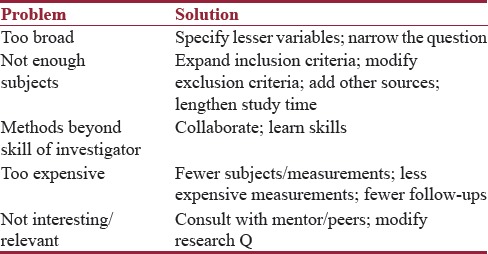
Figure from Ratan et al. 2019.
Over the next couple of weeks, we will identify a topic and formulate a research question as a class. Everyone will have an opportunity to pitch their ideas, so start thinking!
This process can feel scary, but you will get through it! You have the support of your classmates, along with Crystal and Marshall to help you. Don't hesitate to rely on your scientific community for support. Ideally, this course should be a fun experience where you learn important skills.
How to Do Ecology (the book for this class):
Our next class meeting

Our first R homework is due this Friday (4/4) after class. Please submit your R homework in the Google Drive.
Update with agenda (subject to change):
10:40 - self-guided observations; plants, inverts and vertebrates. General observations and exploration remaining time.
11:30 - reconvene and group discussion
How do the readings impact your observations? Do any potential study questions come to mind? How are these different organismal groups interconnected?
12:00 - Depart Putah Creek
Observation Activities and Questions (Putah Creek)
Plant community observations (Putah Creek):
How many tree and shrub species do you count? Collect a leaf from each species that has leafed out. Do you think any of these species are invasive?How do you think seasonality is affecting plants right now? What life stage are they in? How might this change over the quarter?
Invertebrate community observations
Spend 10 minutes observing the invert community. Either choose a group/individual to observe or see how many different types of inverts you can spot. Where did you see the most inverts, the fewest?Vertebrate community observations
Lastly, observe the vertebrate community. Which types of vertebrate groups did you observe? What are some challenges with observing vertebrates?Discussion Questions
How did the readings impact your observations? How are these different groups of organisms interconnected?What general patterns did you observe in the riparian area? Do any potential study questions come to mind? What was your favorite type of organism to observe?
Stebbins Cold Canyon activity
Using Seek and Merlin, how many organisms can you identify? What was the most interesting to you?
Notebook
Throughout class and afterward, please document observations in your notebook. Don't forget that we will read through your notebook at the end of the quarter, so make sure to use it. The formatting of your notebook is completely up to you! You should also document anything you do outside of class in the notebook as well. I recommend taking reading notes especially!
Whew, that was a long one! I'm excited for our day out on Friday!! See you all then :)
References:
Ratan SK, Anand T, Ratan J. Formulation of Research Question - Stepwise Approach. J Indian Assoc Pediatr Surg. 2019 Jan-Mar;24(1):15-20. doi: 10.4103/jiaps.JIAPS_76_18. PMID: 30686882; PMCID: PMC6322175.


Comments
Post a Comment